In an era of constant digital connection, leaders and organizations are experiencing a growing sense of fragmentation, disengagement, and mistrust. This article explores why the hunger for presence, meaning, and real connection is intensifying—and why horses, as unusually honest mirrors of human behavior, are becoming powerful teachers for the kind of leadership this moment demands.
The Longing for Connection in Modern Leadership
I hear a version of the same question from leaders again and again—often quietly, sometimes with frustration:
Why does leadership feel harder to do well than it used to?
They’re not talking about strategy. Or effort. Or commitment. They’re pointing to something less tangible but deeply felt. Despite constant communication and unprecedented connectivity, something essential isn’t landing. Conversations feel thinner. Trust takes longer to build. Influence requires more energy than it once did.
There is a peculiar irony at the center of modern leadership. The more connected we become, the harder genuine connection seems to get.
We live in what some have begun to describe as the Anti‑Social Century—an era of near‑total digital availability in which many people report feeling more disconnected and emotionally adrift than ever before. Shared meals are disappearing. Spontaneous conversation is in decline. The ordinary social rituals that once created a felt sense of belonging—those unscheduled, unmediated moments of being with someone—are steadily eroding under the pressure of speed, screens, and increasingly solitary habits.
Leaders cannot afford to treat this as a cultural observation. It’s a leadership problem.
Why Disconnection is a Leadership Problem, Not a Social Trend
Disconnected organizations don’t just underperform. They fragment. Trust erodes quietly. Alignment becomes performative. And when people can’t make sense of what they’re doing—or why it matters—the discretionary energy that fuels real engagement and commitment evaporates.
 What modern organizations need, desperately, are leaders who can cultivate presence in leadership. These are leaders who help people make meaning in an increasingly incoherent world. Not through clever messaging or polished narratives, but through the quality of their attention, behavior, and lived consistency.
Why the Search for Meaning Is Intensifying at Work
This is not a question of engagement surveys or cultural slogans. It is a deeper reckoning with the gap between outward productivity and inner coherence.
People aren’t just craving more meaningful work. They’re craving proof that genuine human—and human‑adjacent—interaction is still possible. They want environments that respond to them. Spaces where cause and effect feel legible. Leadership that can be felt, not just understood.
Which is precisely why there is a growing appetite for experiential leadership development—learning that is tactile, immediate, and unmediated.
From Novelty to Relevance
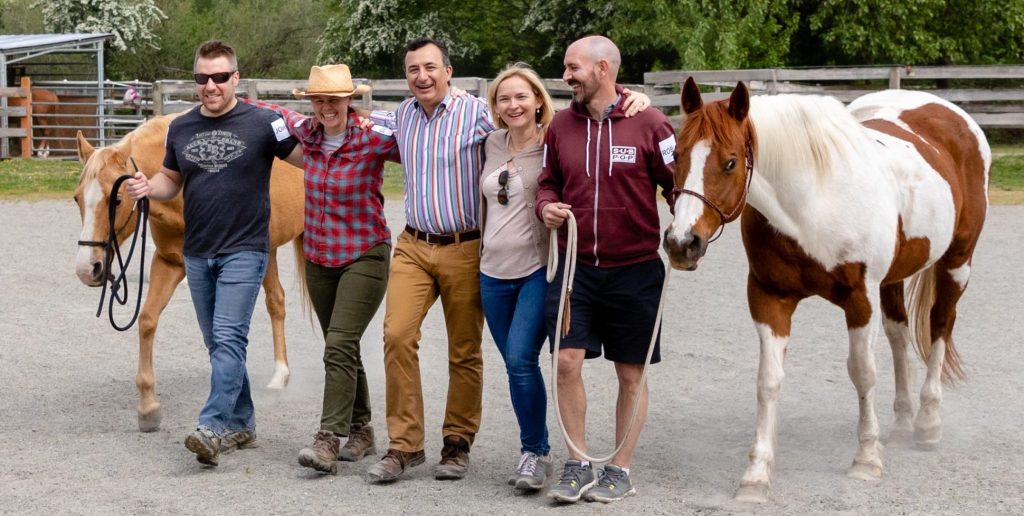
Leadership development involving horses is not new. Equine‑assisted leadership development has existed quietly on the margins for decades, often dismissed as unconventional or niche.
What has changed is the cultural moment meeting it.
As digital abstraction accelerates, practices rooted in physical presence, relational clarity, and real‑time feedback have become newly relevant. What once felt novel is now, for many leaders, essential.
Cultural Signals Leaders Should Not Ignore
Before dismissing leadership with horses as metaphor or novelty, it’s worth understanding the cultural signals that are making this work particularly resonant right now.
The Return to the Physical and the Local
Millennials and Gen Z are gravitating toward analog experiences, physical spaces, and community‑based environments. Not because they’ve rejected the digital world, but because they’re compensating for what it cannot provide.
Research suggests this isn’t nostalgia for the past so much as a longing for emotional intelligibility—the experience of being in environments where responses feel human, immediate, and real.
Gen Z and the Limits of Digitization
Most striking of all, Gen Z—the most digitally native generation in history—is actively returning to in‑person environments. Not as Luddites, but as pragmatists who intuitively understand that something essential doesn’t survive digitization.
What they’re searching for, and rewarding leaders for providing, is presence that feels real.
These aren’t aesthetic preferences. They are signals about what leaders must become if they want to retain trust, motivation, and engagement.
Why Horses Are Extraordinary Teachers of Leadership

Into this landscape comes an interaction that is, by definition, everything the digital world is not: honest, physical, immediate, and unimpressed with status.
Horses are more than a metaphor for leadership. They are sentient, highly sensitive beings who respond to what is actually happening—not what is intended, performed, or claimed.
What makes them extraordinary is not what they do to leaders, but what becomes possible between them. This is embodied leadership development in its most honest form.
Horses Respond to Alignment, Not Just Intention
Clear intention matters. Horses recognize it immediately. But intention alone isn’t enough if it isn’t fully physically expressed in our body.
Horses process micro‑signals—muscle tension, breath patterns, spatial attention, energetic direction—with extraordinary sensitivity. They respond not just to what a leader means, but to whether their intention is supported by the body’s actual signals.
When intention and embodiment are aligned, movement happens. When they aren’t, the horse simply doesn’t follow.
This is the same leadership alignment problem that quietly undermines leaders in human systems—the gap between what leaders believe they’re communicating and what others actually experience.
The horse makes this gap impossible to ignore. In doing so, the horse offers something most leadership feedback never does: the unvarnished truth about how you land.
Misalignment and the Signals Leaders Actually Send
Horses neutralize every advantage that doesn’t matter. Most leaders advance in organizations because of cognitive skill, language fluency, and strategic competence.
Horses are immune to all of it.
They don’t care how compelling your narrative is, how confident you sound, or how decorated your track record. They care whether your signals are coherent enough to be followed.
This strips leadership to its operational core:
- Are you actually clear?
- Are you trustworthy?
- Do your internal state and external behavior align?
For many leaders, discovering that a lifetime of verbal sophistication can coexist with profound physical misalignment is one of the most destabilizing, and valuable, insights they encounter.
How Horses Make Emotional State Visible
Human organizations are remarkably tolerant of emotional masking. Leaders can be privately anxious, conflicted, or scattered while presenting composure, and teams adapt to absorb the cost without ever naming its source.
Horses close that gap entirely.
A leader carrying unacknowledged tension produces scattered results. A leader whose anxiety leaks into their movement creates confusion in motion. A leader who issues directive signals while inwardly uncertain generates hesitation.
Horses render emotional consistency not a soft skill
but a bottom-line requirement for getting anything done.
Influence, Pressure, and Invitation
Every interaction with a horse is, at its core, a study in influence: whether a leader leads through clarity or pressure.
Over‑assert, and the horse resists or shuts down.
Under‑signal, and the horse takes over.
Mix the two, and hesitation follows.
What emerges isn’t a lesson in horsemanship, but a live demonstration of relational dynamics that play out in every team meeting and every request for alignment.
The horse doesn’t judge these patterns. It reflects them.
Followership Without Obligation
Perhaps the most profound gift horses offer leaders is this: they cannot be made to follow through authority, incentives, or obligation.
A horse follows when the request is clear, the timing is right, and the interaction feels navigable.
For many leaders, the moment a horse chooses to follow them—freely and without pressure—is quietly electric.
And almost immediately, a deeper question arises:
Back in my organization, am I actually creating followership—or relying on compliance I’ve mistaken for trust?
Why the Body Learns What the Mind Forgets
Most leadership development produces insight that dissolves under pressure.
With horses, learning is sensory, kinetic, and relational. When a leader feels the difference between force and invitation, between scattered and grounded, that knowledge embeds in the body’s memory.
It becomes available not just when the leader is thinking carefully—but when they’re tired, stressed, or moving fast.
The body remembers what the horse already knows.
What Leadership Culture Is Asking for Now
The signals are everywhere: people want less abstraction and more meaning, less appearance and more consistency, less performance and more intelligible human behavior. People are increasingly sensitive to incongruence—between values and behavior, confidence and clarity, authority and trust.

Why Leadership with Horses Fits this Moment
Horses have no tolerance for this gap. And in that refusal, they are unusually good teachers for the moment we are in. The leaders who will matter most in the next decade will be those who can create belonging, regulate their internal state under pressure, and build trust through lived behavior over time. This is exactly what leadership with horses makes visible—and teachable.
It’s not a new definition of leadership. It’s a very old one
What’s new is the urgency—
and the willingness to learn it in the most honest classroom available.
Curious?
If this reflection resonates, you may already sense that traditional leadership tools aren’t addressing something essential.
Leadership with Horses offers a rare opportunity to experience—not just think about—how your leadership actually lands. It reveals what becomes possible when intention, embodiment, and behavior align.
If you’re curious about what your leadership signals are truly communicating, I invite you to explore this work further. Call me at (425) 488-7747 or email me. We’re booking for 2026 and 2027 now.
Read More Leadership Insights
- Pause and Reflect: It’s Good for Your Leadership – Explore powerful self‑reflection questions that help you deepen your awareness and strengthen your leadership presence.
- Why Horses Are the Best EQ Teachers – Discover how horses make emotional intelligence visible in real time, revealing the subtle signals leaders send—and how those signals shape trust, influence, and followership.
- Is Your Experience Getting in the Way of Your Effectiveness? – A thoughtful examination of how past success can quietly limit present‑day leadership effectiveness, and what it takes to stay responsive rather than reactive.
Amanda Madorno is a leadership development guide and founder of Leadership with Horses, where she works with senior leaders and teams seeking greater clarity, trust, and embodied presence. Her work integrates equine assisted learning, behavioral psychology, and decades of experience observing how leadership actually lands in relational systems. Amanda specializes in helping leaders close the gap between intention and impact—creating leadership people feel, trust, and willingly follow.


This is such an excellent article and speaks to the wisdom of horses and what they can teach us as humans.
This is such an excellent article and speaks to the wisdom of horses and what they can teach us as humans.
Thank you Carol!